Tag: saving money

  • How to Automate Your Savings (An Easy Pay-Yourself-First Setup)

    How to Automate Your Savings (An Easy Pay-Yourself-First Setup)

    This post contains affiliate links. As an Amazon Associate, bananfew earns from qualifying purchases. See the affiliate disclosure.

    If you plan to save “whatever’s left” at the end of the month, there’s usually nothing left. The easier way is to automate your savings, so the money moves before you have a chance to spend it.

    Key takeaways

    • Automatic saving means money goes to savings on a schedule, without you remembering to move it.
    • The two simplest setups are a split direct deposit through work or a recurring transfer from your bank.
    • Start with a small amount you won’t miss, then raise it when your income goes up.
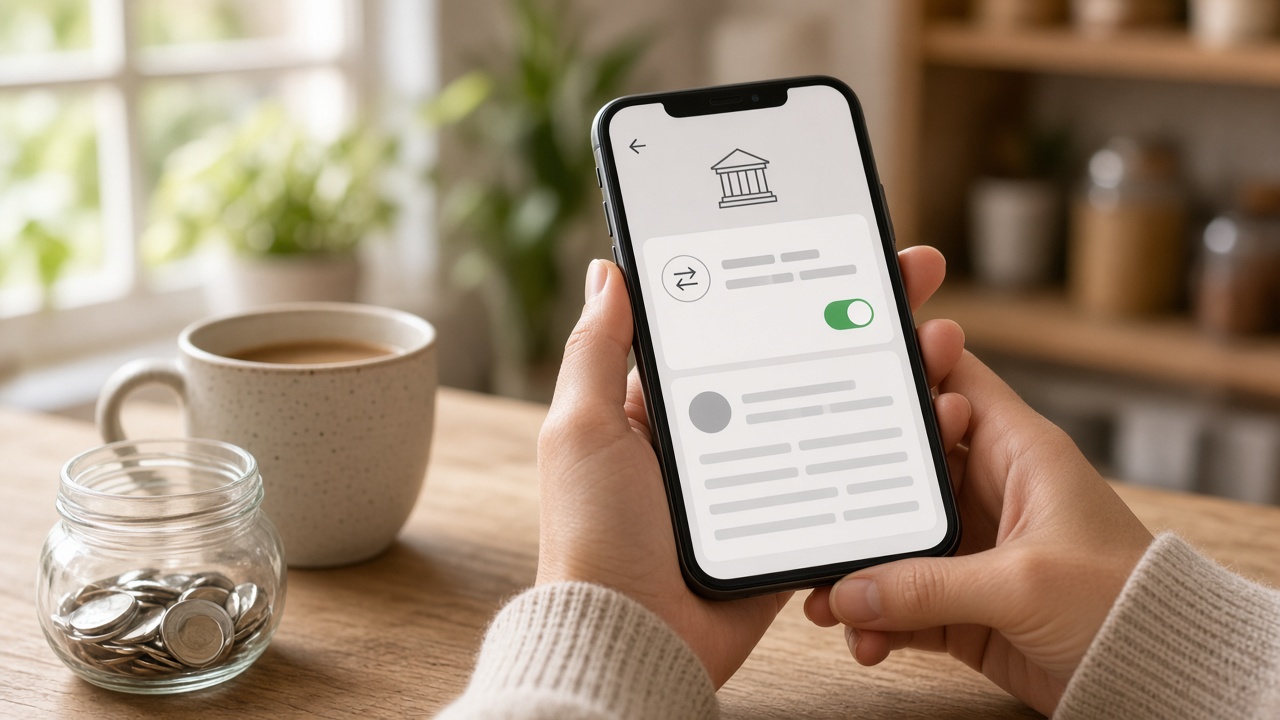
    Hands holding a phone with a recurring savings transfer switched on, next to a coffee mug and a jar of coins, to automate savings

    Why Pay Yourself First Works

    “Pay yourself first” means savings comes out of your paycheck first, like a bill, instead of last. You then spend what’s left in checking.

    The Consumer Financial Protection Bureau calls automatic saving one of the easiest ways to make saving consistent, because once it’s set up, you keep contributing without thinking about it (CFPB).

    Here’s a simple example with made-up numbers. Moving $25 every payday on a two-week schedule adds up to $650 in a year, before any interest. You didn’t have to decide to save 26 separate times.

    Option 1: Split Your Direct Deposit

    If you get paid by direct deposit, you may be able to send part of each paycheck straight to savings. The CFPB notes your employer has to offer both direct deposit and the option to split it between accounts (CFPB).

    How to set it up:

    • Check your payroll portal or ask HR. Many payroll systems let you add a second account yourself. Some use a form.
    • Have your savings routing and account numbers ready. They’re in your bank’s app or on its website.
    • Pick a fixed dollar amount or a percent. A fixed amount is easier to plan around at first.
    • Watch your next paycheck. Changes can take a pay period or two to kick in, so confirm the split landed where you expected.

    This is the most hands-off option, since the money never sits in checking where it’s easy to spend.
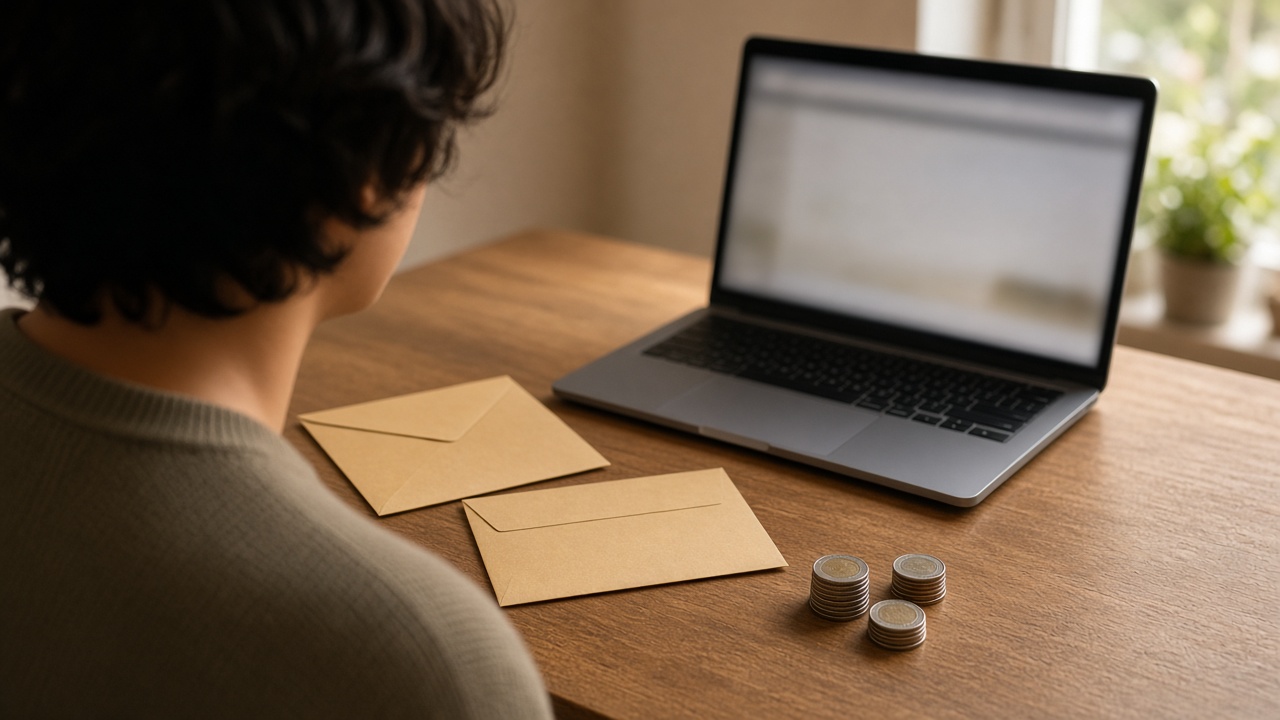
    Person at a laptop with two envelopes and coins split into stacks, setting up split direct deposit to send part of a paycheck to savings

    Option 2: Set Up a Recurring Transfer

    If your job doesn’t offer split deposits, or your income comes from side work, use a recurring transfer. Most banks and credit unions let you schedule one from checking to savings in their app.

    A few tips to make it work:

    • Schedule it a day or two after payday. That gives your paycheck time to post first.
    • Match how often you get paid. Weekly pay, weekly transfer. Twice a month, twice a month.
    • Watch your balance. The CFPB warns that a transfer can cause an overdraft if checking runs low, so set a low-balance alert or a calendar reminder.

    If your income changes from month to month, start with a smaller transfer. You can always move extra over by hand in a good month.

    Keeping the date in one place helps. A simple bill calendar works well for paydays, bills, and transfer dates.

    Calendar with paydays circled next to a phone while writing a reminder to schedule an automatic savings transfer after payday

    How Much to Save When You Automate Your Savings

    Pick an amount that feels almost too small. If $20 a paycheck is what fits, start there. A small transfer you keep is better than a big one you cancel next month.

    Then give the money a job. Good first targets:

    For savings you might need soon, keep it in a separate savings account at a bank or credit union. Check that it’s federally insured, by the FDIC for banks or the NCUA for credit unions. A separate account also makes the money a little harder to spend on a whim.

    If you’d like to go deeper on putting your money on autopilot, Ramit Sethi’s book I Will Teach You to Be Rich spends a good chunk of time on automating savings and bills.

    Keep It Going

    Automation works best when you check on it now and then. A quick weekly money check-in is enough to catch a missed transfer or a low balance.

    When you get a raise, bump your transfer up by part of it before you get used to the bigger paycheck. You’ll still feel the raise, and your savings grow faster.

    This post is for general education, not personal financial advice. Check your bank’s and employer’s own rules before you set anything up.

    Your Start-Today Checklist

    • Open or pick a separate savings account.
    • Check whether your payroll lets you split direct deposit.
    • If not, schedule a recurring transfer a day or two after payday.
    • Choose a small amount you won’t miss.
    • Give the money a job, like a starter emergency fund.
    • Set a low-balance alert on checking.

    Set up one automatic transfer today, even a small one. Future you will be glad the decision is already made.

    Discuss this on X

  • How to Lower Your Heating Bill This Winter (Simple, Low-Cost Fixes)

    How to Lower Your Heating Bill This Winter (Simple, Low-Cost Fixes)

    This post contains affiliate links. As an Amazon Associate, bananfew earns from qualifying purchases.

    Your heating bill can jump the first cold month of the year and quietly wreck a budget that worked fine all fall. The good news is you can lower your heating bill with a few cheap fixes and small habits, most of which take an afternoon or less.

    Key takeaways

    • The thermostat is the biggest free lever: a lower setting while you sleep or are away adds up over a whole winter.
    • Drafts around doors and windows leak heat you already paid for, and the fixes are cheap.
    • Plan for winter bills ahead of time so a high month doesn’t land on a credit card.
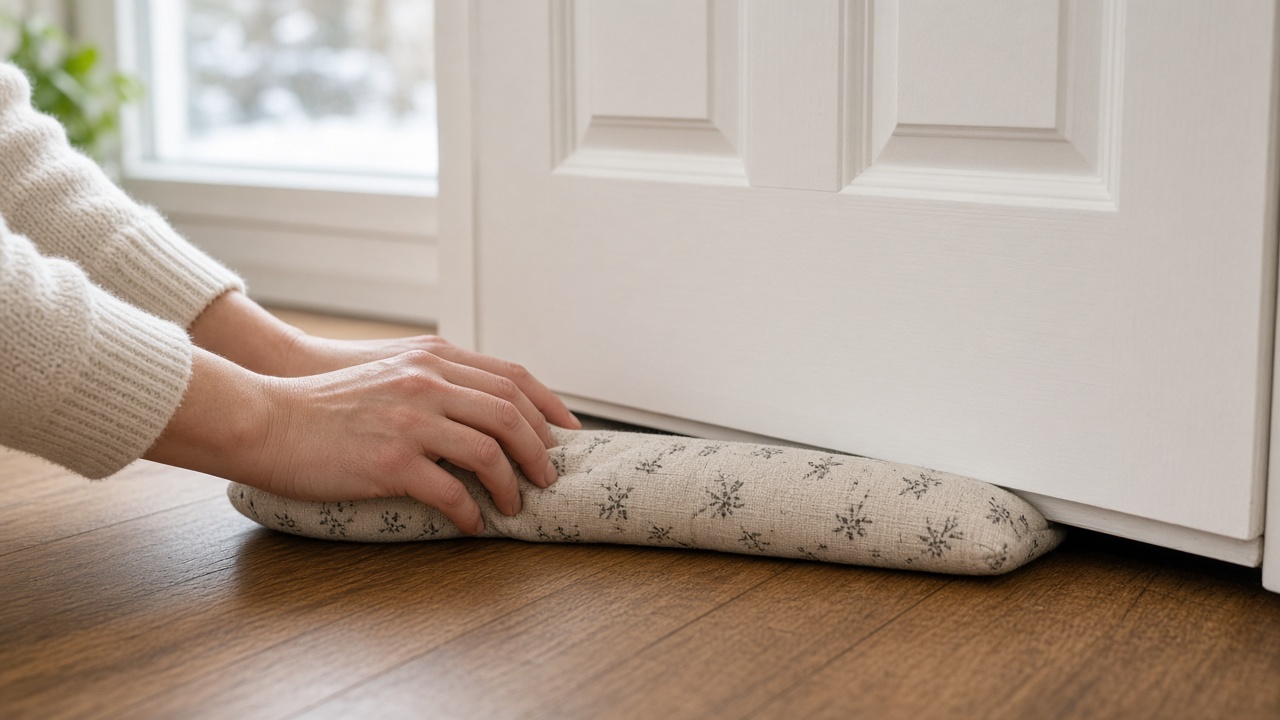
    Hands placing a fabric draft stopper under a door to block cold air and lower the heating bill

    Start With the Thermostat (It’s Free)

    Heating can make up almost half of a typical family’s winter energy bill, according to the U.S. Department of Energy’s home energy checklist. So small changes here go a long way, and you don’t need a fancy device to start.

    The DOE’s Energy Saver guide says you can save as much as 10% a year on heating and cooling by turning your thermostat down 7 to 10 degrees for 8 hours a day in the fall and winter. Nighttime and workdays are the easy windows for that.

    Here’s a simple way to try it:

    • Pick your daytime number. Try 68ยฐF and add a sweater before you touch the dial.
    • Set back at night. Drop it a few degrees when you go to bed and use an extra blanket.
    • Set back when you leave. If no one is home during the workday, there’s no reason to heat an empty house.

    One note: if you have a heat pump, the same DOE guide says not to do big setbacks unless you have a smart or programmable thermostat made for heat pumps, because a setback can kick on pricier backup heat. With a heat pump, a steady, moderate setting is usually the better move.

    Block Drafts Around Doors

    A gap under a door is like leaving a small window open all winter. Warm air slips out, cold air slides in, and your heater runs longer to keep up.

    Here’s a quick test. On a windy day, hold your hand or a lit incense stick near the bottom and edges of each outside door. If you feel cold air or the smoke wavers, you’ve found a leak.

    The cheapest fix is a rolled towel at the bottom of the door. A step up is an under-door draft stopper that slides on and moves with the door, which works well for renters since nothing gets glued or screwed in.

    Check the sides and top of the door too. Worn weatherstripping there can be replaced with a peel-and-stick strip from any hardware store.

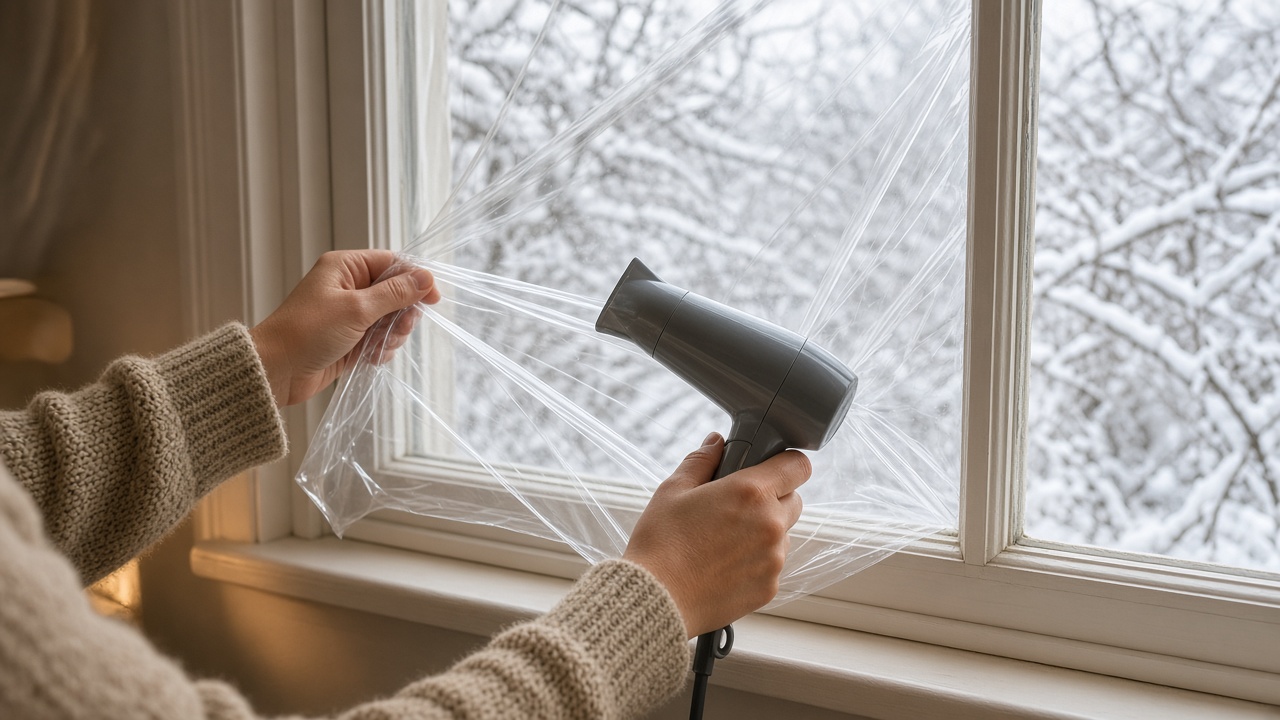
    Applying clear window insulation film with a hair dryer to stop winter drafts and cut heating costs

    Seal Up Drafty Windows

    Older windows lose a lot of heat, especially single-pane ones or frames that don’t close tight. Replacing windows is expensive, but you don’t have to.

    • Lock every window. Locking pulls the sashes tighter together and can close small gaps.
    • Use window film. A clear shrink film window kit goes on with tape and a hair dryer and comes off in spring. It adds a layer of still air between you and the cold glass.
    • Close curtains at night. Open them on sunny days to let the sun warm the room for free, then close them after dark to hold the heat in.

    Start with the room you use most, like the living room or bedroom. You’ll feel the difference there first.

    Small Habits That Keep Heat Where You Want It

    None of these cost money. Together they help your heater do less work.

    • Close vents and doors in unused rooms only if your system allows it. Some systems run better with every vent open, so check your manual first.
    • Change or clean your furnace filter. A clogged filter makes the system work harder. Many need a look every one to three months.
    • Don’t block vents or radiators with couches or long curtains.
    • Run ceiling fans clockwise on low. This gently pushes warm air from the ceiling back down.
    • Dress for the season indoors. Warm socks, slippers and a throw on the couch let you keep the thermostat lower without feeling it.

    Plan for Winter Bills Before They Hit

    Even after these fixes, a cold January can still bring a bigger bill. The goal is to see it coming so it doesn’t end up on a credit card.

    Here’s a sample, not real numbers. Say your heating bill runs about $80 in fall and $180 in your coldest months. That’s an extra $100 a month for about three months, or $300 to plan for.

    • Look at last winter. Most utilities show 12 months of past bills online. Find your highest month so you know what to expect.
    • Ask about budget billing. Many utilities offer a plan that spreads your yearly cost into equal monthly payments. Call and ask if yours does.
    • Start a small sinking fund. Put aside a little each month for winter bills. Here’s how sinking funds stop surprise bills.
    • Put the due date on your calendar. A simple bill calendar helps you avoid late fees on top of a bigger bill.

    If you’re struggling to pay for heat, call your utility before you fall behind and ask about payment plans. You can also look into the federal Low Income Home Energy Assistance Program (LIHEAP), which helps eligible households with heating costs.

    Any money you save each month can go to work too. Add it to your first $1,000 emergency fund or put it toward debt with the Debt Destroyer Planner.

    This post is for general education, not personal financial or home-repair advice. Savings will vary by home, climate and heating system.

    Your Start-Today Checklist

    • Set your thermostat to 68ยฐF while you’re home and lower at night.
    • Do the hand test on every outside door and window.
    • Block the worst door gap with a towel or draft stopper.
    • Seal or cover your draftiest window.
    • Check your furnace filter.
    • Look up last winter’s highest bill and ask your utility about budget billing.

    Pick one item and do it today. A warmer house and a smaller bill usually start with the door you already know is drafty.

    Discuss this on X

  • How to Stop Impulse Buying With a Simple 48-Hour Rule

    How to Stop Impulse Buying With a Simple 48-Hour Rule

    This post contains an affiliate link. As an Amazon Associate, bananfew earns from qualifying purchases.

    Most money leaks don’t come from one big mistake. They come from the “it’s only $25” buys that show up when a sale email lands or you’re scrolling late at night, and a simple 48-hour rule is one of the easiest ways to stop impulse buying without giving up the things you really want.

    Key takeaways

    • The 48-hour rule is simple: when you want something you didn’t plan for, write it down and wait two days before you buy it.
    • A short wait list in your phone or a pocket notebook turns “I need this now” into a calm yes or no.
    • Cutting the triggers, like sale emails and saved cards, does as much work as willpower.
    Hand writing a wait list in a small pocket notebook to stop impulse buying

    Why Impulse Buying Adds Up So Fast

    An impulse buy is anything you didn’t plan to buy before you saw it. A phone case, a kitchen gadget, a second hoodie in a different color.

    Each one feels too small to matter. The trouble is that they repeat, and they rarely show up in a budget because you never planned for them.

    Here’s a sample, not a real budget. Say you make three unplanned buys a week at about $20 each.

    That’s $60 a week, or roughly $3,120 a year. If even half of those would fail a two-day wait, that’s about $1,560 you could send to savings or a credit card instead.

    How the 48-Hour Rule Works

    The rule has one step: you don’t buy anything unplanned on the same day you first want it. You wait 48 hours, then decide.

    That’s it. You aren’t saying no. You’re saying “not yet,” which is much easier to stick with.

    Step 1: Write it down. Add the item, the price and today’s date to a wait list. A notes app works, or a small pocket notebook you keep in your bag or by your laptop.

    Step 2: Close the tab or walk away. Don’t leave it sitting in your cart. Carts are built to pull you back.

    Step 3: Check the list after two days. Ask three quick questions. Do I still want it? Do I know where it will go or when I’ll use it? Can I pay cash for it without touching savings or bill money?

    Step 4: Decide on purpose. If all three answers are yes, buy it and enjoy it. If not, cross it off.

    A lot of people find that most items on the list feel boring by day two. The want was real in the moment, but it passed.

    Set Your Own Wait Times

    Forty-eight hours is a good default, but you can scale it to the price. Bigger purchases deserve a longer pause.

    • Under $50: wait 48 hours.
    • $50 to $200: wait one week.
    • Over $200: wait 30 days and check that it fits your budget before you buy.

    Pick numbers that fit your income. The point is to have the rule decided ahead of time, so you aren’t making it up while a “sale ends tonight” banner is flashing.

    Planned things don’t need to wait. Groceries on your list, a bill, or a gift you budgeted for are already decided. If you use a simple cash envelope system, anything that fits inside an envelope you already filled can skip the wait.

    Laptop inbox full of store sale emails being cleared out to cut impulse spending

    Cut the Triggers Before Black Friday

    Willpower gets tired. It’s easier to remove the nudges that start most impulse buys in the first place, and late November is the best time to do it.

    • Unsubscribe from store emails. Spend 10 minutes this week unsubscribing from every shop that emails you more than once a week. You can still visit the site when you need something.
    • Remove saved cards. Delete your card from shopping sites and apps. Typing the number in by hand adds a small pause, and that pause helps.
    • Turn off shopping app alerts. Price-drop and “back in stock” alerts are designed to make you buy now.
    • Shop with a list. Before Black Friday, write down the few things you actually planned to buy and a total you’re willing to spend. Anything not on the list goes to the wait list.

    If your holiday budget isn’t set yet, start with how to plan holiday spending without debt. It pairs well with the 48-hour rule.

    And while you’re cleaning up, it’s a good time to find and cancel unused subscriptions. Many of those started as impulse sign-ups too.

    Give the Money You Didn’t Spend a Job

    Skipping a buy only helps if the money actually goes somewhere. Otherwise it tends to drift into the next purchase.

    Once a week, look at what you crossed off your wait list and add it up. Then move that amount on purpose.

    If you don’t have a cushion yet, send it toward your first $1,000 emergency fund. If you’re paying down debt, put it toward your next payment. The Debt Destroyer Planner can help you see which debt it should go to first.

    Your 10-minute weekly money check-in is a natural time to do this. It also shows you patterns, like which store or time of day keeps showing up on your list.

    This post is for general education, not personal financial advice. Savings will vary by household.

    Your Start-Today Checklist

    • Start a wait list in your phone or a small notebook.
    • Pick your wait times: 48 hours, one week and 30 days.
    • Unsubscribe from three store emails today.
    • Remove your saved card from one shopping app.
    • Write your planned Black Friday list and a spending limit.
    • Add up crossed-off items each week and move that money to savings or debt.

    Try it with the very next thing you want to buy. Write it down, wait two days, and see how often the answer turns into “I’m good.”

  • How to Start a Simple Cash Envelope System (Even If You Mostly Use Cards)

    How to Start a Simple Cash Envelope System (Even If You Mostly Use Cards)

    This post contains an affiliate link. As an Amazon Associate, bananfew earns from qualifying purchases.

    If your card balance always surprises you at the end of the month, the problem usually isn’t one big purchase. It’s a lot of small swipes you don’t feel, and a simple cash envelope system makes those swipes visible again.

    Key takeaways

    • A cash envelope system puts a set amount of cash into a few labeled envelopes, and when an envelope is empty, that category is done until the next refill.
    • You only need envelopes for the two or three categories where you tend to overspend, not your whole budget.
    • Bills, savings and debt payments can stay automatic while cash handles the everyday spending.
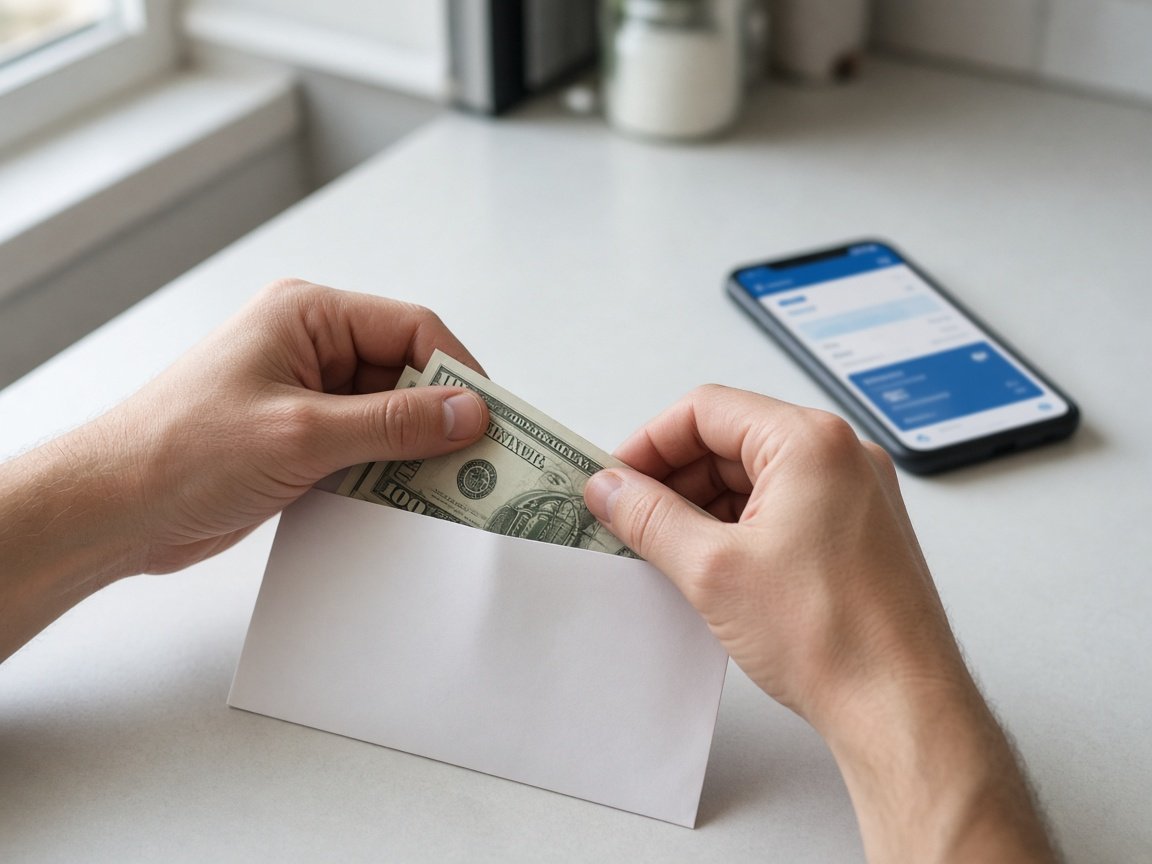
    Hands filling a cash envelope on payday to start a cash envelope budget

    What a Cash Envelope System Is (and Why It Works)

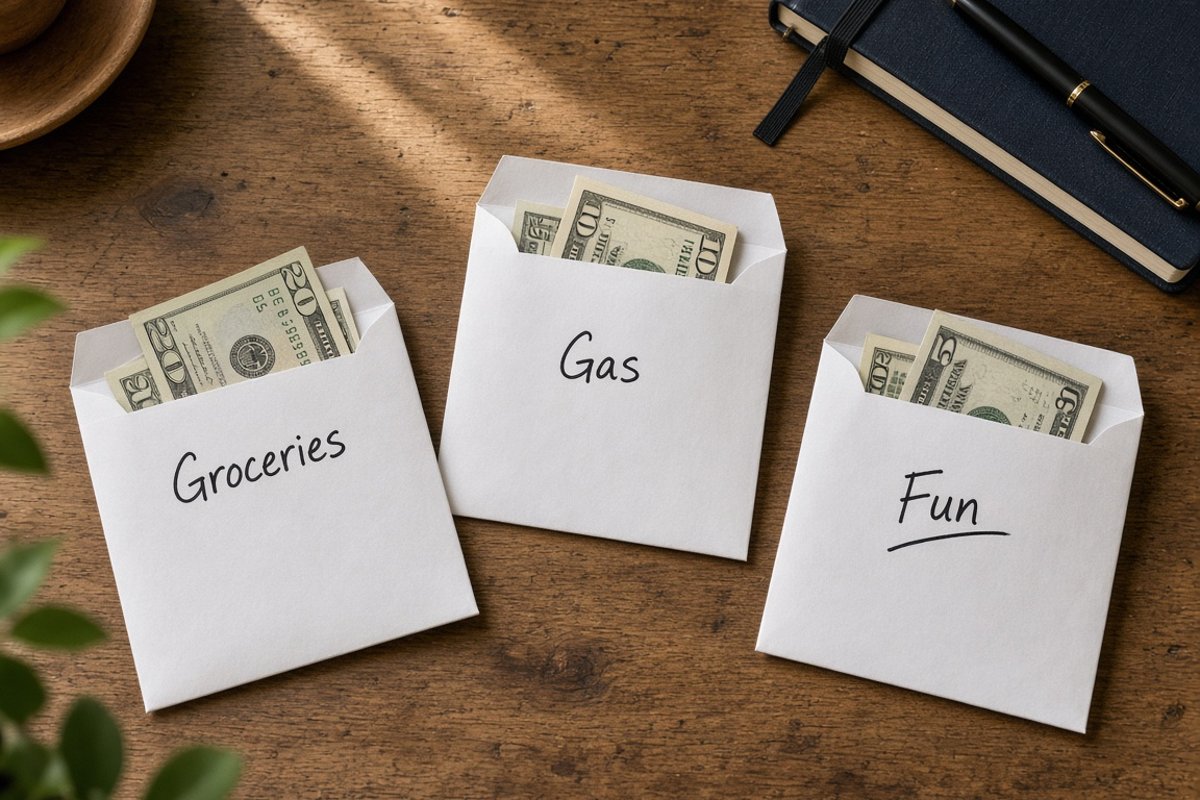
    The idea is old and plain. On payday, you take out cash for a few spending categories, like groceries, gas and fun money. Each category gets its own envelope with a set amount inside.

    When you buy groceries, you pay from the grocery envelope. When it’s empty, you stop spending in that category or move money over from another envelope on purpose.

    It works because cash is easy to see. A card feels the same whether you have $400 left or $4. An envelope with two $10 bills in it tells you exactly where you stand before you reach the register.

    Here is a sample, not a real budget. Say you plan $120 a week for groceries and usually spend about $150 by card.

    With $120 in an envelope, you see the money run low by Thursday and plan a pantry dinner instead of a third trip. That’s $30 a week you didn’t spend, or roughly $1,560 over a year if it holds.

    How to Set Up Your Cash Envelopes in 20 Minutes

    You don’t need a fancy kit to start. Plain envelopes and a pen are enough for the first month.

    Step 1: Look at last month’s spending. Open your bank or card statement and add up what you spent on groceries, gas, eating out and other everyday stuff. This gives you real numbers instead of guesses.

    Step 2: Pick two or three categories. Choose the ones where you overspend most often. For many people that’s groceries, eating out and “fun” spending like shopping or hobbies.

    Step 3: Set an amount for each one. Start close to what you actually spend, then trim a little. Going from $300 to $150 in one month usually ends with an empty envelope on day eight and giving up.

    Step 4: Match the refill to your payday. If you’re paid every two weeks, fill the envelopes every two weeks. If cash for a full month feels like too much to carry, split it into weekly amounts.

    Step 5: Label and fill them. Write the category and the amount on each envelope. Some people keep a small note inside to jot down each purchase.

    If you’d rather not use loose paper envelopes, a small budget binder with zipper cash envelopes keeps everything in one place and comes with spending sheets.

    What Stays on Autopilot

    A cash envelope system is for everyday spending. It isn’t meant for rent, utilities or your phone bill.

    Keep fixed bills on automatic payments from your checking account. A simple bill calendar helps you line those due dates up with payday so the cash you pull out never belongs to a bill.

    Savings and debt payments should stay automatic too. If you’re building your first $1,000 emergency fund or paying down a card, set that transfer up first. Then fill your envelopes with what’s left for spending.

    Yearly costs like car registration or holiday gifts fit better in sinking funds held in a savings account than in a stack of cash at home.

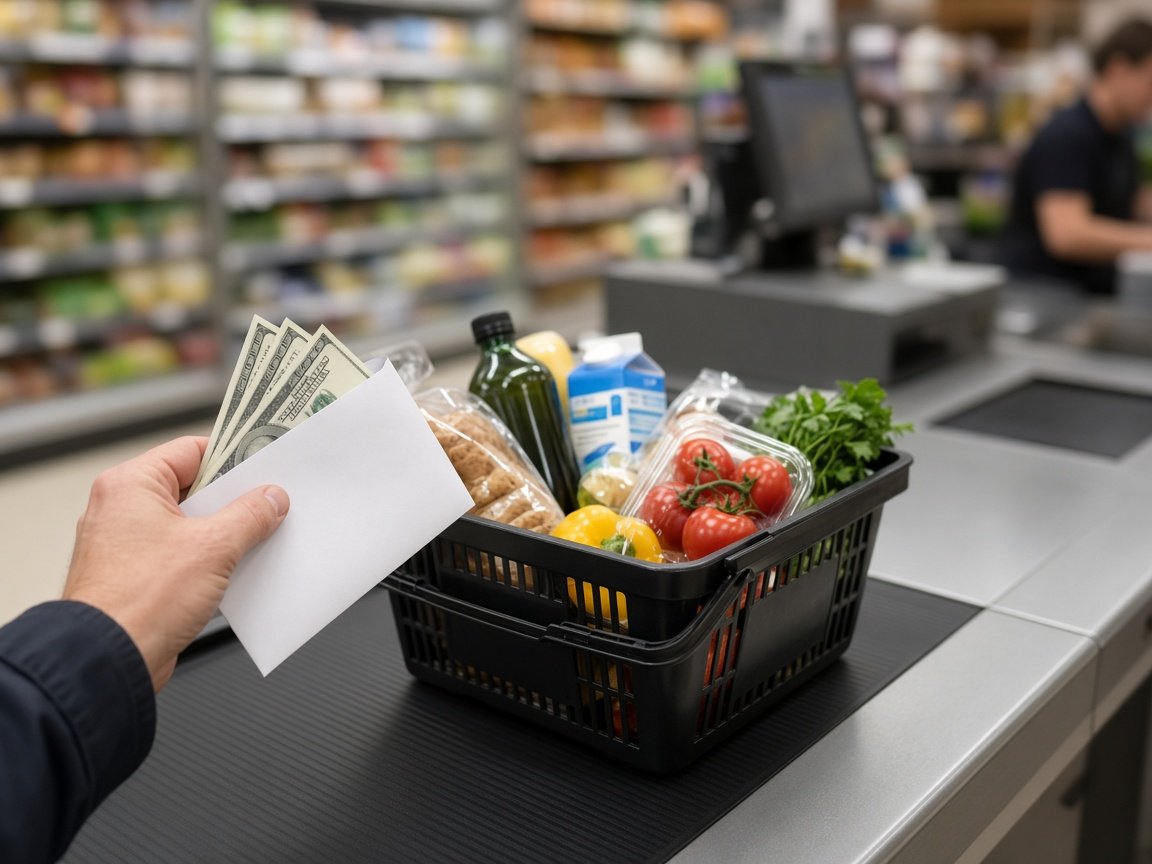
    Shopper paying for groceries with cash from a grocery envelope at checkout

    Using Envelopes When You Mostly Pay by Card

    Some stores and bills don’t take cash, and carrying a lot of it isn’t always safe. You can still use the same idea.

    • Keep only one or two envelopes in cash. Groceries and fun money are the easiest to start with. Everything else stays on your debit card.
    • Use a digital envelope. Some banks let you split your checking or savings into named buckets. Move each category’s amount into its own bucket on payday and spend only from that.
    • Track it on paper. If you pay by card, write the purchase on the envelope and subtract it. When the number hits zero, that category is done.
    • Keep cash safe. Don’t carry more than you plan to spend that week, and keep the rest at home in one place.

    Check your envelopes during your 10-minute weekly money check-in. It’s the quickest way to see which category runs out first and adjust before the next payday.

    What to Do When an Envelope Runs Out Early

    It will happen, especially in the first month. That’s useful information, not a failure.

    First, decide if the amount was realistic. If groceries run out every week, raise that envelope a little and lower another one to match. The total should still fit your income.

    Second, borrow on purpose. Moving $20 from fun money to groceries is fine. Reaching for a credit card without thinking is the habit you’re trying to break.

    And if there’s money left at the end of the period, give it a job. Roll it into next month, add it to savings, or send it to the debt you’re paying off. If you’re working through several debts, the Debt Destroyer Planner can show you where extra money goes furthest.

    This post is for general education, not personal financial advice. Spending amounts and savings will vary by household.

    Your Start-Today Checklist

    • Add up last month’s spending on groceries, gas, eating out and fun.
    • Pick two or three categories for envelopes.
    • Set an amount for each, close to what you spend now, then trim a little.
    • Keep bills, savings and debt payments automatic.
    • Fill your envelopes on your next payday.
    • Check them at your weekly money check-in and adjust.

    Start small with one envelope this payday. Seeing exactly what’s left before you spend is often all it takes to start saving money and stop the end-of-month surprise.

  • How to Cut Your Grocery Bill With a Simple Weekly Meal Plan

    How to Cut Your Grocery Bill With a Simple Weekly Meal Plan

    This post contains an affiliate link. As an Amazon Associate, bananfew earns from qualifying purchases.

    Groceries are one of the few big bills you can change this week, not next year. A simple weekly meal plan is the easiest way to cut your grocery bill, and it takes about 20 minutes once you know the steps.

    Key takeaways

    • Most grocery overspending comes from extra trips, impulse buys and food that goes bad before you use it.
    • Planning four or five dinners around what you already have covers most of the week.
    • A short list, one leftovers night and a quick weekly check keep the plan working.
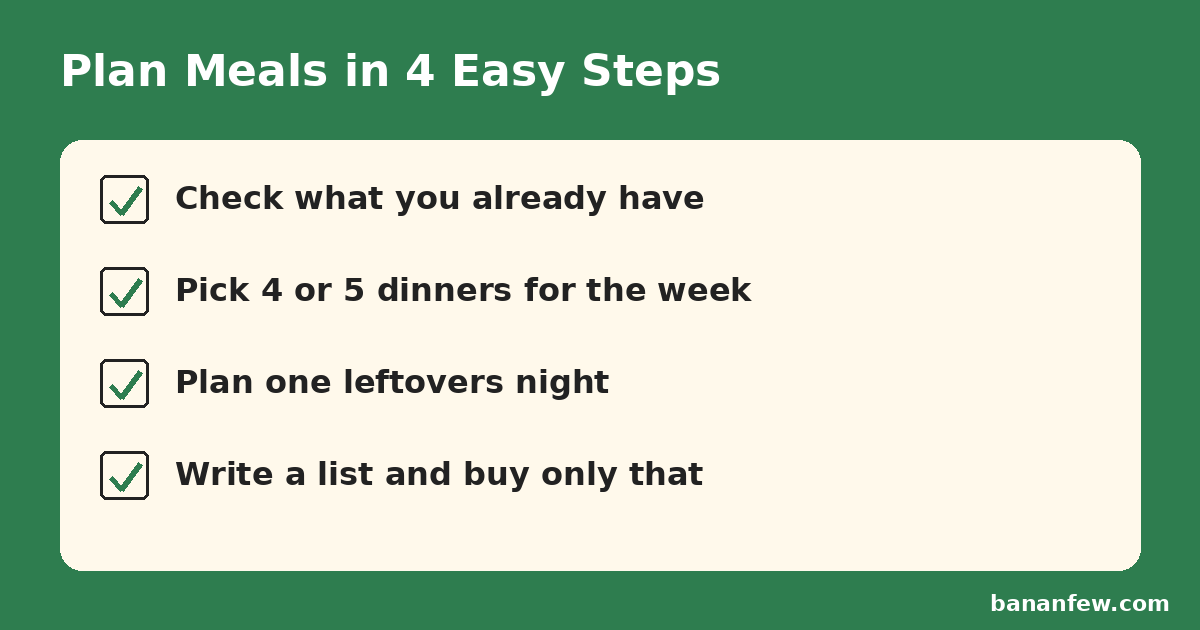
    Four easy steps to make a weekly meal plan that cuts your grocery bill

    Why a Weekly Meal Plan Cuts Your Grocery Bill

    When you shop without a plan, you buy for the week you hope to have. Then a busy Tuesday shows up, the spinach wilts, and you order takeout anyway.

    A meal plan fixes three leaks at once. You make fewer trips, so there are fewer chances to grab extras. You buy only what a meal needs. And you use food before it spoils, because you already know which night it is for.

    Here is a simple example with sample numbers, not a real budget. Say you spend $150 a week on groceries and about $25 of that ends up as extra snacks, a second trip or food you throw away. Trim even half of that and you keep about $12 a week, or about $624 a year. Your numbers will be different, but the leaks are usually there.

    How to Make a Simple Meal Plan in 20 Minutes

    Pick one time each week, like Sunday morning. Grab a notepad or the notes app on your phone.

    Step 1: Shop your kitchen first. Open the fridge, freezer and pantry. Write down anything that needs to be used soon and any staples you already have, like rice, pasta, beans or frozen vegetables.

    Step 2: Pick four or five dinners. Build them around what is on that list. You don’t need seven new recipes. Most people do fine with a few meals they already know how to make.

    Step 3: Plan one leftovers night. Pick a night, often Thursday or Friday, where you eat whatever is left. That one habit stops a lot of food from going to waste.

    Step 4: Write the list and stick to it. Write down only what those meals need, plus breakfast and lunch basics. Group the list by store section so you are in and out faster.

    If you plan to cook once and eat twice, a set of glass meal prep containers makes leftovers easy to stack and grab for lunch.

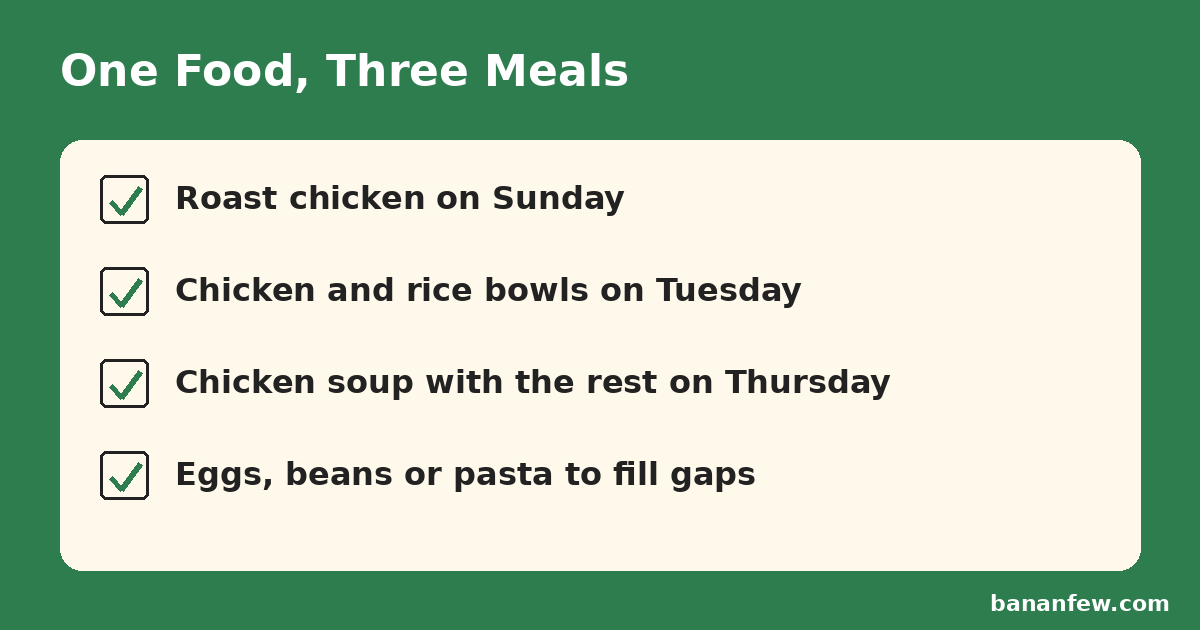
    Cheap weekly meal plan example turning one roast chicken into three dinners

    Stretch One Ingredient Into Several Meals

    The cheapest meal plans reuse the same base ingredient in different ways. You buy one bigger item, which often costs less per pound, and spread it across the week.

    For example, roast a whole chicken on Sunday. Use some of the meat for chicken and rice bowls on Tuesday. Turn the rest into soup on Thursday. Eggs, beans and pasta fill the other nights for very little money.

    The same idea works with a big pot of chili, a bag of rice or a tray of roasted vegetables. If you don’t eat meat, try a pot of lentils or black beans as your base.

    Shop Smarter With Your List

    A plan only saves money if the list makes it to the store with you. A few small habits help it stick.

    • Eat before you shop. Shopping hungry makes snacks look like a good idea.
    • Check unit prices. The small label on the shelf shows the price per ounce or pound, so you can compare sizes and brands quickly.
    • Try the store brand. For basics like flour, canned tomatoes and frozen vegetables, store brands often cost less.
    • Leave room for one swap. If something on your list is far more than you expected, swap it for a cheaper item that fits the same meal.

    Then look at your receipt during your 10-minute weekly money check-in. Seeing the total each week shows you whether the plan is working. If you find room in the budget, it can go toward your first $1,000 emergency fund or a debt you are paying off.

    What to Do When the Plan Falls Apart

    Some weeks will go sideways. A late night at work or a sick kid can knock out two planned dinners.

    Keep two or three backup meals in the freezer or pantry, like pasta with jarred sauce or eggs and toast. They cost less than takeout and take about 15 minutes.

    If you skip a planned meal, move it to the next week instead of buying new food. Freeze anything that will not keep. The goal is not a perfect week. The goal is spending less than you would without a plan.

    This post is for general education, not personal financial advice. Food prices and savings vary by store, location and household.

    Your Start-Today Checklist

    • Pick one planning time each week and put it on your calendar.
    • Write down what is already in your fridge, freezer and pantry.
    • Choose four or five dinners and one leftovers night.
    • Write a short grocery list grouped by store section.
    • Keep two cheap backup meals on hand.
    • Check your grocery total at your weekly money check-in.

    Start with this week’s dinners. Twenty minutes with a notepad today can mean fewer trips, less waste and a smaller grocery bill by Sunday.